
Make your company easier for AI to understand and easier for buyers to shortlist, prefer and choose.
HiFuture Consulting is a strategic B2B marketing consultancy for AI-mediated buying. We work with CMOs, executive teams, and sales leaders across AI Visibility, Thought Leadership, and Account-Based Social Selling to make companies easier for AI systems to understand and buyers to trust, shortlist, prefer, and choose.
We connect company knowledge, identifiable experts, and independent validation into one coherent authority system, then activate that authority across the AI-mediated buying journey.
The objective is clearer market interpretation, earlier preference, buyer-initiated high-intent engagement, stronger buying-group support, and a decision stakeholders can confidently support.
The buying journey is now AI-mediated and the first competitive battle often happens before Sales can see it.
Buyers use AI systems, search, expert content, peers, vendor websites, partners, media, and external sources to frame problems, identify categories, compare vendors, and prepare decisions.
By the time direct contact begins, a shortlist and early preference may already exist. After Sales enters, Marketing still has work to do: reinforce authority, activate experts, expand buying-group coverage, supply decision-ready proof and guidance, and reduce uncertainty.
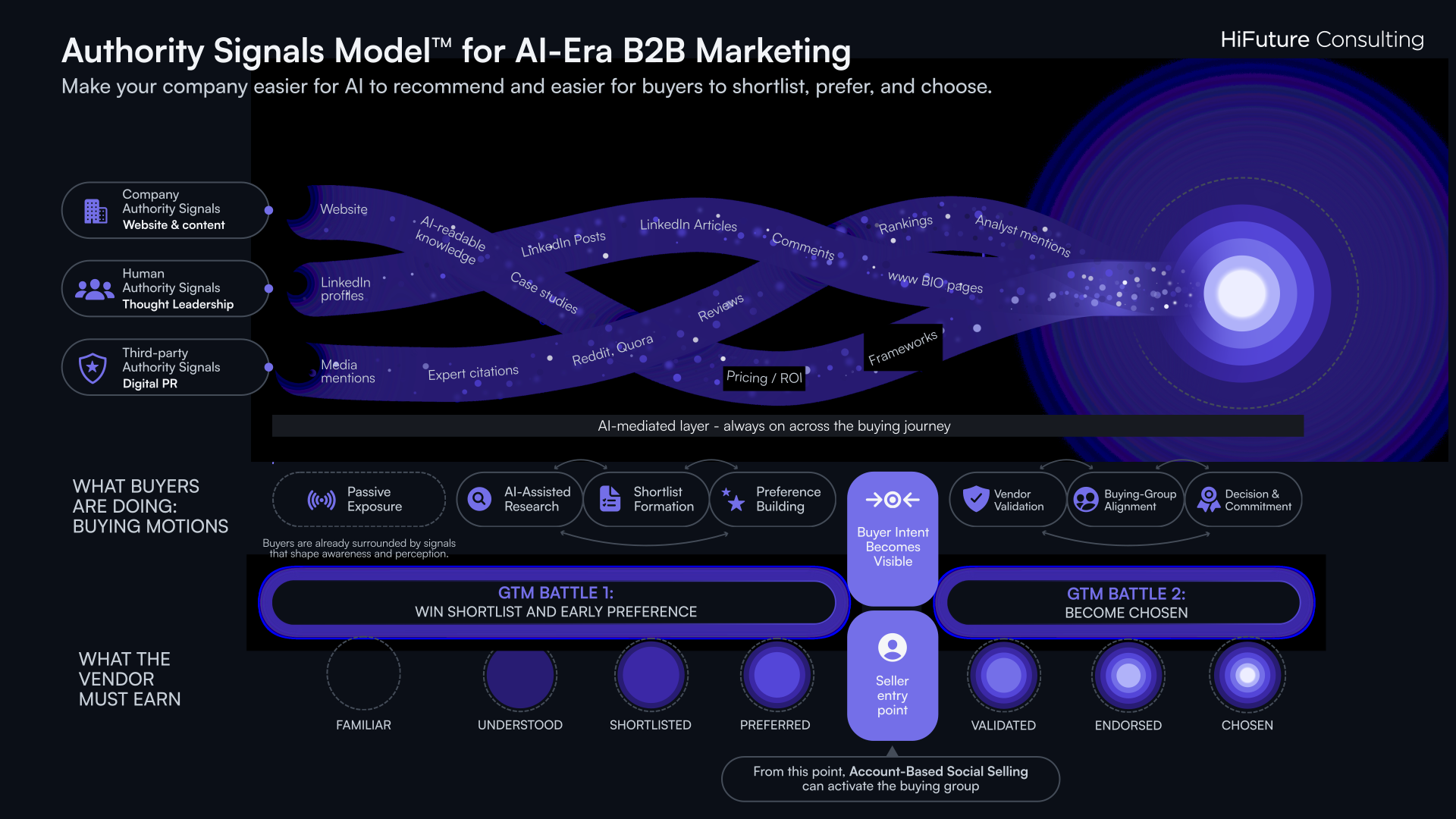
First Battle - Win early preference
Before engagement
Become discoverable, correctly interpreted, shortlisted, and preferred before the buyer contacts Sales.
Second Battle - Become chosen
After engagement
Activate the buying group, validate the vendor, reduce perceived risk, and build enough shared confidence to support the decision.
HiFuture Consulting combines AI Visibility, B2B buying-journey strategy, Thought Leadership, Account-Based Social Selling, and authority-building capabilities within one operating logic. The work is led by Katarzyna Sitarska and supported by proprietary frameworks including Authority Orchestration™, the Authority Signals Model™, Authority Fragmentation, and the Human Authority Scaling Effect™.

Authority Orchestration™
Authority Orchestration™ is the strategic marketing discipline of designing, connecting, and activating Authority Signals as one consistent ecosystem across the buying journey - so AI systems can accurately interpret, attribute, cite, and recommend the company, buyers can trust and prefer it, and the organization can turn that preference into a winning decision.
Authority Orchestration™ does not replace SEO, GEO, content, Thought Leadership, Digital PR, ABM, Social Selling, or Sales Enablement. It is the strategic layer that makes those capabilities reinforce one market position and buying logic.
Authority Orchestration™ does not replace SEO, GEO, content, Thought Leadership, Digital PR, ABM, Social Selling, or Sales Enablement. It is the strategic layer that makes those capabilities reinforce one market position and buying logic.
Authority Signals Model™
Company knowledge provides depth. Identifiable experts make that knowledge attributable. Independent sources provide external context and validation. Together, they create a stronger basis for buyer trust, AI interpretation, early preference, and decision support
Company Authority Signals | What does the organization know and prove?
Signal group 1Organization-owned knowledge, positioning, methodologies, evidence, website content, cases, decision assets, and capability explanations.
Built through AI-ready website and knowledge architecture, pillar pages, FAQs, methodologies, frameworks, case studies, research, pricing, ROI/TCO, comparisons, implementation, and decision content.
Human Authority Signals | Who demonstrates the expertise?
Signal group 2Attributable expertise from Executives, Subject-Matter Experts, and Sales Professionals across profiles, content, events, conversations, and external sources.
Built through Executives, Subject-Matter Experts, and Sales Professionals across expert pages, LinkedIn, authored articles, webinars, video, comments, events, public speaking, and buyer interactions. Authority scales through attributable expertise – not content volume alone.
Third-Party Authority Signals | Who independently validates it?
Signal group 3Independent validation from customers, media, analysts, partners, communities, publications, peer references, and other credible open sources.
Built through customers, partners, analysts, media, external publications, citations, reports, reviews, rankings, certifications, communities, and relevant open sources.
We shape how AI and buyers interpret your company
We connect company knowledge, identifiable experts, and independent validation into one coherent authority system, then activate that authority across the AI-mediated buying journey. The objective is clearer market interpretation, earlier preference, buyer-initiated high-intent engagement, stronger buying-group support, and a decision stakeholders can confidently support.
Step 1
Diagnose
Understand the current situation
Assess how the company is interpreted by AI systems and buyers, how its knowledge, experts, proof, and external validation appear, and where gaps limit visibility, preference, or buying-group confidence.
Outcome:
baseline, area scores, priority gaps, implementation direction
baseline, area scores, priority gaps, implementation direction
Step 2
Prioritise
Focus on what matters most
Identify the categories, expertise domains, Authority Signals, programs, and commercial actions that should come first - not everything at once.
Outcome:
Strategy Deck, operating model, implementation catalogue
Strategy Deck, operating model, implementation catalogue
Step 3
Implement
Put programs into operation
Implement the website and knowledge, Thought Leadership, Digital PR, Account-Based Social Selling, buying-group activation, and other priority work the organization actually needs.
Outcome:
a working authority system around agreed business priorities
a working authority system around agreed business priorities
Step 4
Orchestrate
Keep the whole system aligned
Coordinate Marketing, Sales, executives, experts, partners, agencies, ownership, governance, and measurement around one market position and buying logic.
Outcome:
Reassessment to repeat the original measurement against the baseline to show what changed.
Reassessment to repeat the original measurement against the baseline to show what changed.
Who HiFuture Consulting works with?
We offer our services to the B2B organizations that want to grow in a strategically important offer area, sell through complex buying journeys, and have valuable expertise that is not yet working as one visible system. Company size is secondary to the complexity of the offer, markets, buying journey, teams, experts, agencies, and partners involved.
|
Type |
Outcome |
Solution |
|
Technology vendors |
Make specific solutions and use cases easier to recognize. |
A strong corporate brand may not translate into visibility for a particular product, category, solution, or buying problem. |
|
Professional services & consulting |
Scale authority beyond founders and a few visible partners. |
Knowledge is the product, but the wider expert base may remain underused, weakly attributed, or disconnected from the firm. |
|
Professional services & consulting |
Build an identity stronger than the vendor catalogue. |
Vendor brands may be more visible than your own organization while your methodologies, experts, customer proof, and implementation capability remain difficult to distinguish. |
|
Professional services & consulting |
Make complex execution capability easier to understand and trust. |
Delivery competence may be strong while buyers and AI systems cannot reconstruct the full expertise, differentiation, proof, risk control, and implementation credibility required for a complex decision. |
Who are we not the right fit for?
- You are looking only for a quick GEO/SEO tactic, guaranteed AI ranking, or anonymous content volume.
- You cannot involve a CMO or Marketing owner, CEO or board sponsor, relevant experts, or business owners when strategic decisions are required.
- You want diagnosis only but are not prepared to assign ownership, resources, or implementation after priorities are agreed.
- Your sales environment is purely transactional and does not depend materially on expertise, trust, proof, or a buying group.
What are most common clients' challenges?
See what are organisations' most frequent problems and see how to solve them.
"AI knows our brand, but does not recommend us for the right categories, problems, or shortlists."
Buyers research independently, use AI, and may form a shortlist and preference before becoming visible. We need a Marketing operating model that influences the full journey.
Start with AI Visibility & Authority Assessment™"Our Marketing model still starts with campaigns, leads, and handoff to Sales."
Buyers research independently, use AI, and may form a shortlist and preference before becoming visible. We need a Marketing operating model that influences the full journey.
Explore: AI-Era B2B Marketing"We have strong executives and experts, but their expertise is difficult to find or weakly connected to the company."
Authority depends too heavily on the corporate brand, the founder, or a few visible people. Valuable knowledge is not consistently attributable to the experts who possess it.
Explore: Thought Leadership"We know the opportunity or champion, but not the wider buying group."
Relationship coverage is weak, relevant stakeholders are missing, and Sales, presales, executives, experts, and Marketing are not coordinating account engagement.
Explore: Account-Based Social SellingDiagnose first. Prioritise what matters. Implement what is needed. Orchestrate the whole system.
We activate founders, experts and commercial teams as visible, trusted signals in the market.